
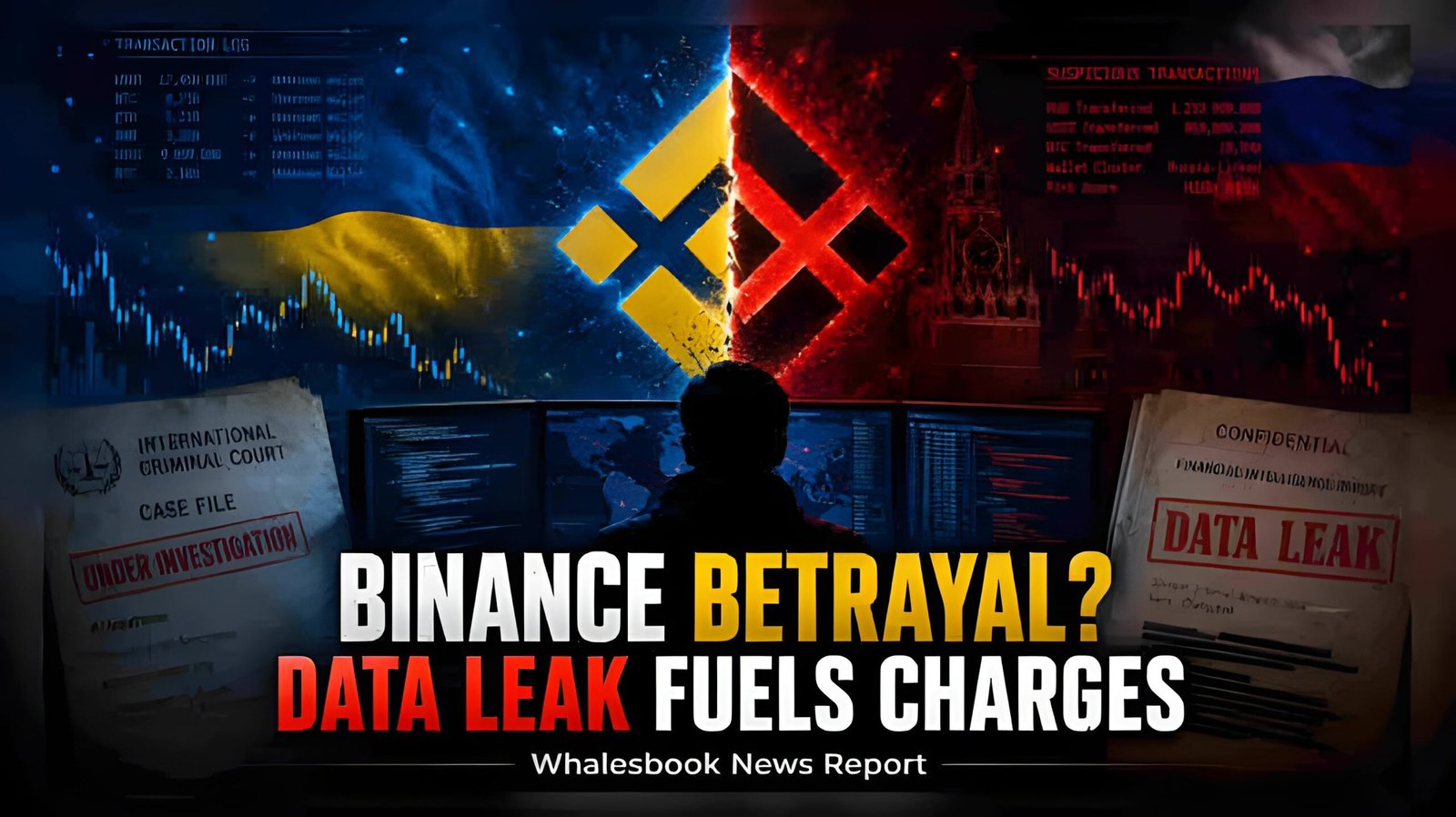
Newly reviewed law enforcement records show that Binance Russia data sharing helped Russian investigators build a terrorism financing case against a Russian IT worker who donated cryptocurrency to Ukrainian military-linked groups. The documents, reviewed by Reuters, show Binance turned over the man’s transaction history to Russian authorities last year, even though the exchange had publicly said it left the Russian market back in 2023.
The case centers on 49-year-old Yuri Belenkiy, who holds both a Russian passport and a Bulgarian residency permit. He was detained in September 2025 and formally charged on October 13, 2025, and he remains jailed in Moscow awaiting trial. Investigators say he sent more than $700 in crypto to Ukraine’s military and an associated group called the Azov Brigade, which Moscow labels a terrorist organization.
The revelation is raising fresh concerns about how much personal data crypto exchanges hold onto, and what happens to that data once a company says it has walked away from a country. It also raises legal questions under European privacy law, since Belenkiy’s Bulgarian residency may have entitled him to stronger data protections than Russian citizens typically receive.
What Happend?
According to the documents, Russian officials asked Binance directly for Belenkiy’s transaction records. Binance responded with data confirming he had sent cryptocurrency to a wallet tied to a Ukrainian military fundraising campaign. That information became a key piece of evidence cited in the criminal case against him.
Russia’s Investigative Committee, the federal agency that handles the country’s most serious criminal cases, said in October that Belenkiy had sent donations to the Ukrainian armed forces and the Azov Brigade. Ukraine and its Western allies do not consider Azov a terrorist group, but Russian authorities have used that designation to prosecute donors.
Investigators say the transfers happened between January 2023 and March 2024. Belenkiy was responding to an online appeal from Arkady Babchenko, an exiled Russian journalist and Kremlin critic who has openly solicited crypto donations to help supply Ukrainian troops with medical equipment. Reuters reviewed several of Babchenko’s posts from that period listing the wallet addresses used to collect the donations.
Babchenko told Reuters he had previously warned people living inside Russia against donating to Ukrainian military fundraisers because of the legal risk. He said he considers it troubling that an exchange would share Russian donors’ identifying details with Russian investigators.
What Officials and the Company Are Saying
A Binance spokesperson defended the company’s actions in a statement to Reuters. The company said it does not write or enforce any country’s laws, does not decide on criminal charges, and does not control how a government uses information once it has been handed over as part of a legal request. The spokesperson said Binance cooperates with lawful requests from law enforcement agencies globally, but that responsibility for those decisions belongs to the government making the request. Binance Russia data sharing declined to comment on the specific details of Belenkiy’s case, saying it does not discuss individual law enforcement matters.
Legal experts, however, say Binance may not have been obligated to comply, and might have actually been barred from doing so under European law. Mike Bystrov, founder of the crypto regulation firm Stellar Consulting, told Reuters that once Binance had exited Russia, it had no legal duty to answer Russian requests. He added that sending personal data to Russia is legally sensitive because the European Union does not consider Russia to have adequate protections for personal information.
Binance Russia data sharing becomes especially important given Belenkiy’s Bulgarian residency. Under the EU’s General Data Protection Regulation, known as GDPR, companies typically must obtain a court order before sharing an EU resident’s personal information with an outside country. If Belenkiy’s Binance account was registered under his Bulgarian residency, the company may have needed judicial approval before turning over his data. Binance did not say whether it views this as a possible violation, and Reuters could not independently confirm how his account was registered on the platform.
Background :A Pattern of Security of Binance Russia data sharing
Binance Russia data sharing :- This is not the first time Binance’s relationship with Russian authorities has drawn attention. Reuters has previously reported that a Binance regional executive met with officials from Russia’s financial monitoring agency back in 2021. At that meeting, officials reportedly sought help identifying people who had donated bitcoin to Alexei Navalny, the jailed Russian opposition leader who died in an Arctic penal colony in 2024. Binance said at the time that Russian authorities had never actually contacted the company about Navalny’s donors.
Binance’s history in Russia has also drawn scrutiny on the sanctions side. After Russia’s full-scale invasion of Ukraine in 2022, Western governments placed sweeping sanctions on major Russian banks. Binance said it would restrict Russian customers and avoid working with sanctioned banks. But other news organizations reported in 2023 that the exchange was still facilitating payments involving sanctioned Russian lenders through its peer-to-peer trading service. Binance said at the time that it followed global sanctions rules and did not maintain direct banking relationships inside Russia.
Taken together, this pattern has fueled concern among digital rights advocates that global crypto exchanges can get pulled into political conflicts even after publicly stepping away from a controversial market.
Impact on Americans
Although this case involves a Russian and Bulgarian citizen, it carries lessons for people in the United States too. Binance has millions of users worldwide, and the company has also faced serious scrutiny from US regulators. In 2023, Binance and its founder reached a major settlement with the US Department of Justice and other federal agencies over violations of American sanctions and anti-money-laundering laws.
For US crypto users, this case is a reminder to think carefully about how much personal information any exchange collects and stores. Account data can potentially be shared with foreign governments under certain circumstances, even at platforms that market themselves around privacy and security. Anyone who donates to international causes using cryptocurrency should understand that these transactions are typically tied to a verified identity rather than staying anonymous.
The Ultimate Interactive Tool for GTA V https://streamtoearn.surge.sh