

Klarna Q2 2026 Earning :-Klarna Group plc, the Swedish “buy now, pay later” company and online bank, posted a surprise profit for the second quarter of 2026. But investors focused on something else: the company’s decision to lower its full-year sales and revenue targets. That news sent Klarna shares tumbling by as much as 19% before U.S. markets opened on Tuesday, August 18, 2026.
The results highlight a split story. On one hand, Klarna’s Q2 2026 earnings beat Wall Street expectations by a wide margin. On the other hand, the company’s leadership is warning that conditions in Germany, its biggest market, are weaker than expected. That warning is why the stock fell so sharply even though the quarterly numbers looked strong.
Klarna trades on the New York Stock Exchange under the ticker KLAR after going public in September 2025. The company is best known in the United States for letting shoppers split purchases into installments at online checkout. It has been working to expand beyond that core business into a broader digital bank, offering debit cards, savings features, and other financial products.

What Happened in Klarna Q2 2026 Earnings
Klarna reported a net profit of $9 million for the April-to-June quarter. That is a big turnaround from a $53 million loss in the same period last year. It also beat what analysts on Wall Street were expecting, which was a loss of roughly $17.4 million.
Revenue for the quarter came in at about $1.04 billion, up 27% from a year earlier. That figure topped analyst forecasts, which had called for revenue closer to $994 million. Klarna’s adjusted operating income, a measure the company uses to track its core profitability, jumped to $91 million from $29 million a year ago. That is a gain of more than 200%.
Gross merchandise volume, or GMV, is the total dollar value of purchases made through Klarna. That number reached $36.6 billion in the second quarter, up 18% compared with last year. Transaction margin dollars, another measure of how much money Klarna keeps after covering the cost of processing purchases, rose 42% to $446 million.
The company said more than 120 million consumers now use its services, and each customer is spending more through Klarna than before. Revenue earned per active customer grew 24% during the quarter, a sign that Klarna Q2 2026 Earning is getting more use out of its existing customer base rather than only adding new users.
Why Klarna Cut Its Full-Year Guidance
Despite the strong quarterly numbers, Klarna trimmed its outlook for the rest of 2026. Klarna Q2 2026 Earning company now expects full-year GMV of between $149 billion and $151 billion. That is down from its earlier forecast of more than $155 billion
Full-year revenue guidance was also reduced, to a range of $4.08 billion to $4.16 billion. That is below the company’s prior target of $4.34 billion, and it falls short of the $4.42 billion that analysts had penciled in.

Klarna Q2 2026 Earning pointed to Germany as the main reason for the change. Germany is the company’s largest market by sales volume, and Klarna said it now has “a more measured view” of how much business it expects to see there through the end of the year. The company did not attribute the softness to a single cause, but the timing lines up with a broader slowdown in German retail spending and tighter regulation of buy-now-pay-later lending across Europe.
Germany has historically been a strong market for installment payments. Many German shoppers are used to paying for online purchases after delivery, a practice sometimes called “Rechnungskauf,” which made Klarna’s payment model a natural fit there. However, German regulators have been folding buy-now-pay-later products into stricter consumer credit rules as part of the European Union’s updated Consumer Credit Directive. That shift is pushing BNPL providers, including Klarna, toward more oversight and clearer borrower protections, which can slow growth in the short term even if it strengthens the market over time.
What Wall Street Expected vs. What Klarna Delivered
Before Tuesday’s report, analysts were bracing for a loss at Klarna, not a profit. The $9 million net profit came as a genuine surprise given the loss forecasts on the street. Revenue also beat expectations, and so did adjusted operating income.
yet stock price often move based on where a company us headed, not just where it has been. When Klarna trimmed its 2026 revenue and volume targets, investors reacted to that forward-looking signal more than the quarter that had already closed. Shares fell as much as 19% in premarket trading Tuesday, a sharp drop for a company that had just reported better-than-expected profit.
This pattern is common in the stock market. A company can report a strong quarter and still see its stock fall if guidance for future quarters disappoints investors. Klarna Q2 2026 Earning situation this week is a clear example of that dynamic playing out.
Klarna’s Guidance for the Third Quarter
Klarna also gave investors a look at what to expect in the third quarter of 2026, which the company described as an “investment quarter“. Klarna plans to spend more on marketing and expanding its payment service provider partnerships during this period, with the financial benefits of that spending expected to show up later.
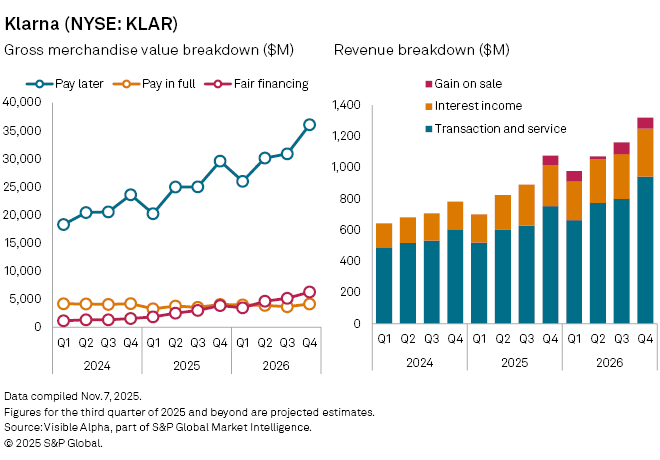
For the third quarter, Klarna Q2 2026 Earning expects GMV of $35 billion to $36 billion, revenue of $940 million to $980 million, transaction margin dollars of $340 million to $360 million, and adjusted operating income of $5 million to $15 million. That adjusted operating income range is notably lower than the $91 million Klarna just posted for the second quarter, reflecting the heavier spending the company has planned.
Why This Matters for U.S Shoppers and Investors
Klarna has become one of the most visible buy-now-pay-later brands in the United States, competing with companies like Affirm and Afterpay for a share of the growing installment-payment market. Klarna said its U.S. business was a key driver of growth in the second quarter, helping offset some of the softness seen in Germany.
For everyday American shoppers who use Klarna to split up payments at checkout, this earnings report does not signal any immediate changes to how the service works. But it does show that Klarna’s growth engine, particularly in Europe, is not as strong as the company previously believed. That matters for U.S. investors who hold Klarna stock, since the company’s shares have been volatile since its New York Stock Exchange debut last September.
The buy-now-pay-later industry as a whole has also been drawing more attention from regulators and consumer advocates in the United States. Critics have raised concerns that installment payment apps can make it easier for shoppers to take on more debt than they realize, especially when they use multiple BNPL services at once and lose track of what they owe. Klarna and its competitors have pushed back on some of those concerns, arguing their products help consumers avoid higher-cost credit card debt when used responsibly.
Background on Klarna’s Business
Klarna was founded in Sweden 21 years ago and has grown into one of the largest BNPL and digital banking companies in the world. The company has been shifting its business model over the past few years, moving beyond simple short-term installment loans at checkout toward a fuller banking relationship with customers. That includes debit cards, interest-bearing loans, and other banking-style products.
This shift has brought new opportunities, including higher revenue per customer, but also new risks. As Klarna extends longer-term loans that carry interest, it also takes on a greater risk of loan losses if customers fail to repay. Investors have been watching this closely as Klarna scales up its lending business alongside its traditional short-term payment product.
Klarna’s initial public offering in September 2025 was one of the most closely watched fintech listings of the year. Since then, the stock has moved up and down along with quarterly results and shifting expectations for growth, a pattern that continued with Tuesday’s sharp premarket decline.
What were Klarna Q2 2026 Earning?
Klarna reported a net profit of $9 million for the second quarter of 2026, compared with a $53 million loss a year earlier.Revenue grew 27% to about $1.04 billion, and both figures beat what analysts on wall street had expected
Why did Klarna’s stock fall after a profitable quarter?
Klarna’s stock fell as much as 19% because the company lowered its full-year revenue and sales volume guidance for 2026. Investors reacted to the weaker outlook for the rest of the year rather than the stronger-than-expected second-quarter results
When did Klarna go public?
Klarna listed on the New York Stock Exchange under the ticker symbol KLAR in September 2025.
How is Klarna’s U.S. business performing?
Klarna said growth in its U.S. markets helped support its overall results in the second quarter of 2026, even as its German business slowed. The U.S. remains an important growth market as Klarna competes with other buy-now-pay-later providers
How to Build a Loyal Fanbase on TikTok Live https://streamtoearn.surge.sh
Holy shit! This site has the most insane ass fucking clips!
The girls take it balls deep and the quality
is top notch.
Finally found a place with proper rough anal action. Ass stretching and messy creampies.
Best anal porn collection I’ve found. The scenes are so brutal and the girls look
sexy as hell.
These hardcore anal clips are addictive. Rough and extremely
hot. Streaming works perfectly.
Insane anal action! Tight asses getting destroyed in the hottest way.
Strongly recommended! Best anal porn ever!
my homepage; free russian porn