
Crypto companies, artificial intelligence firms, and online betting businesses have become the biggest spenders in American politics this year. Together, they are driving record-breaking 2026 midterm election spending that is reshaping how campaigns for the U.S. House and Senate are run.
New numbers from the corporate watchdog group Public Citizen show that companies have already poured $517 million into House and Senate races over a 15-month stretch ending in the first quarter of 2026. That already tops the $461 million companies spent across the entire two-year 2024 election cycle. And the biggest spending push, the final weeks before the November 3 election, hasn’t even happened yet.
This isn’t the same group of donors who used to run the show. For decades, Wall Street banks, oil companies, pharmaceutical giants, and media conglomerates dominated corporate political giving. Now, a newer group of billionaires from crypto, tech, and online betting is taking their place, and they’re spending money in ways that don’t follow old party lines.
What’s Driving the Record 2026 Midterm Election Spending
Three industries are responsible for the bulk of the surge: cryptocurrency, artificial intelligence, and online sports betting. Combined, these three sectors accounted for at least $294 million of all corporate donations to midterm campaigns between January 2025 and the end of the first quarter of 2026, according to Public Citizen’s tracking.
Rick Claypool, research director at Public Citizen, said the scale of corporate spending this cycle has no real precedent. Corporate money now dominates so much of the conversation in Washington that lawmakers spend an outsized share of their time on narrow regulatory fights involving crypto and AI, even as everyday Americans are more focused on the cost of groceries and healthcare, Claypool said.
That tension sits at the center of the debate over 2026 midterm election spending. Supporters of the new wave of corporate giving argue it simply gives fast-growing industries a voice that older sectors have had in Washington for generations. Critics counter that it lets a small number of wealthy donors crowd out the pocketbook issues that matter most to ordinary voters.
Even so, money doesn’t guarantee political success. Polling shows most Americans believe there’s too much money in politics already. Progressive Senate candidates such as James Talarico in Texas and Abdul El-Sayed in Michigan have built parts of their campaigns around criticizing the outsized influence of wealthy donors and corporations.
How the Money Moves: Super PACs and Dark Money
Much of this new corporate cash flows through a web of super PACs, affiliated PACs, and dark money nonprofits. Super PACs and their affiliates can raise and spend unlimited amounts of money, but they are legally barred from coordinating directly with candidates or giving money straight to their campaigns. Dark money groups add another layer, since they aren’t required to publicly disclose their donors.
Instead of writing checks straight to campaigns, these groups spend on television and digital ads, organize get-out-the-vote drives, and sponsor rallies. Companies and their executives often give to several of these groups at once, on top of any personal donations they make directly to candidates or campaigns.

Some of the country’s wealthiest tech executives are spending heavily on their own. SpaceX founder Elon Musk has already put more than $90 million toward the 2026 federal elections, with plans to spend significantly more before November. Google co-founder Sergey Brin spent over $106 million fighting a proposed wealth tax and other ballot issues in California. Meta, the parent company of Facebook and Instagram, has donated $65 million spread across four super PACs backing candidates from both parties in state races in California, Texas, Illinois, and other states.
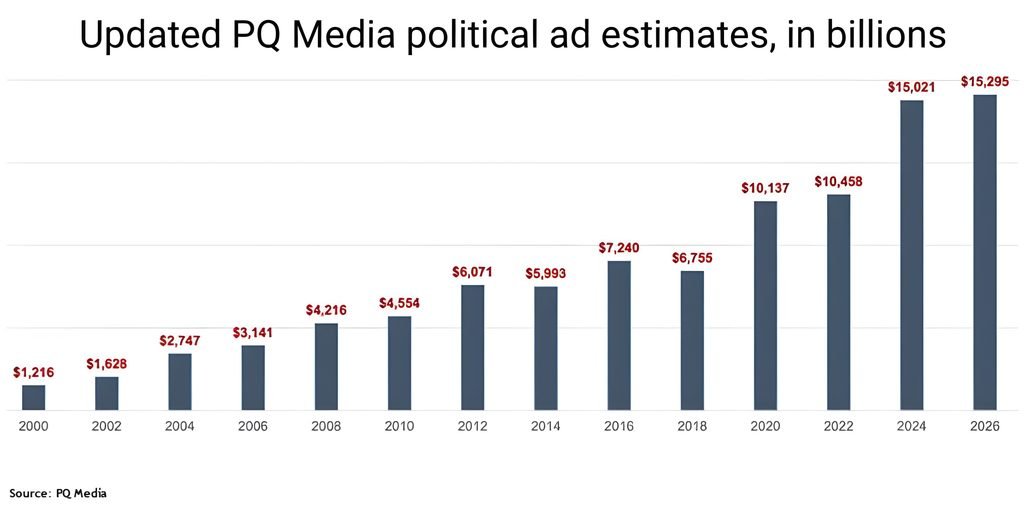
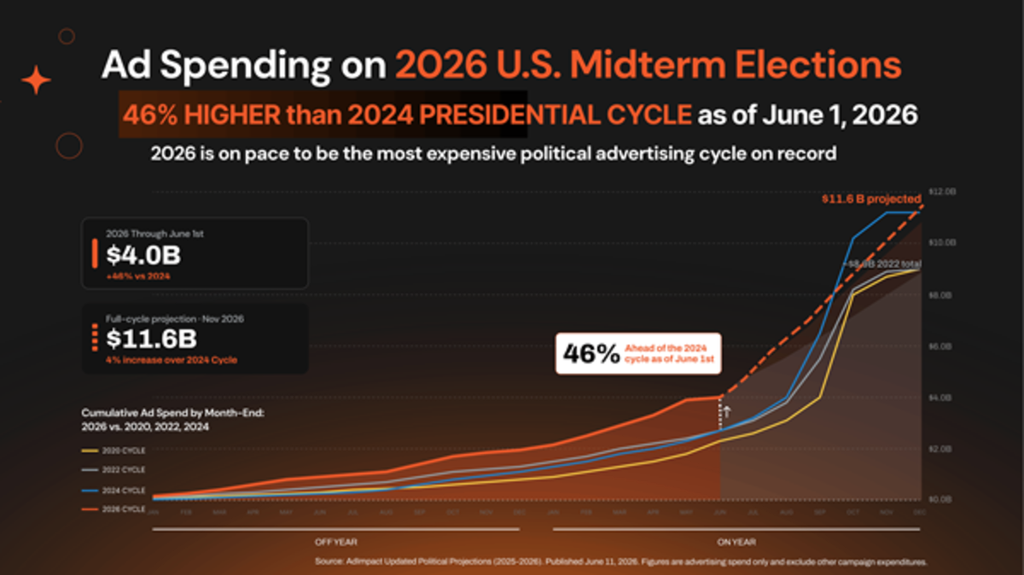
Zooming out to include every type of political spending, not just corporate money but donations from billionaires, labor unions, and advocacy groups, the ad-tracking firm AdImpact projects a record $11.6 billion will be spent on political advertising for the 2026 midterms. That would break the previous record of $11.2 billion set during the 2023-2024 election cycle.
Crypto Wrote the Playbook Everyone Else Is Copying
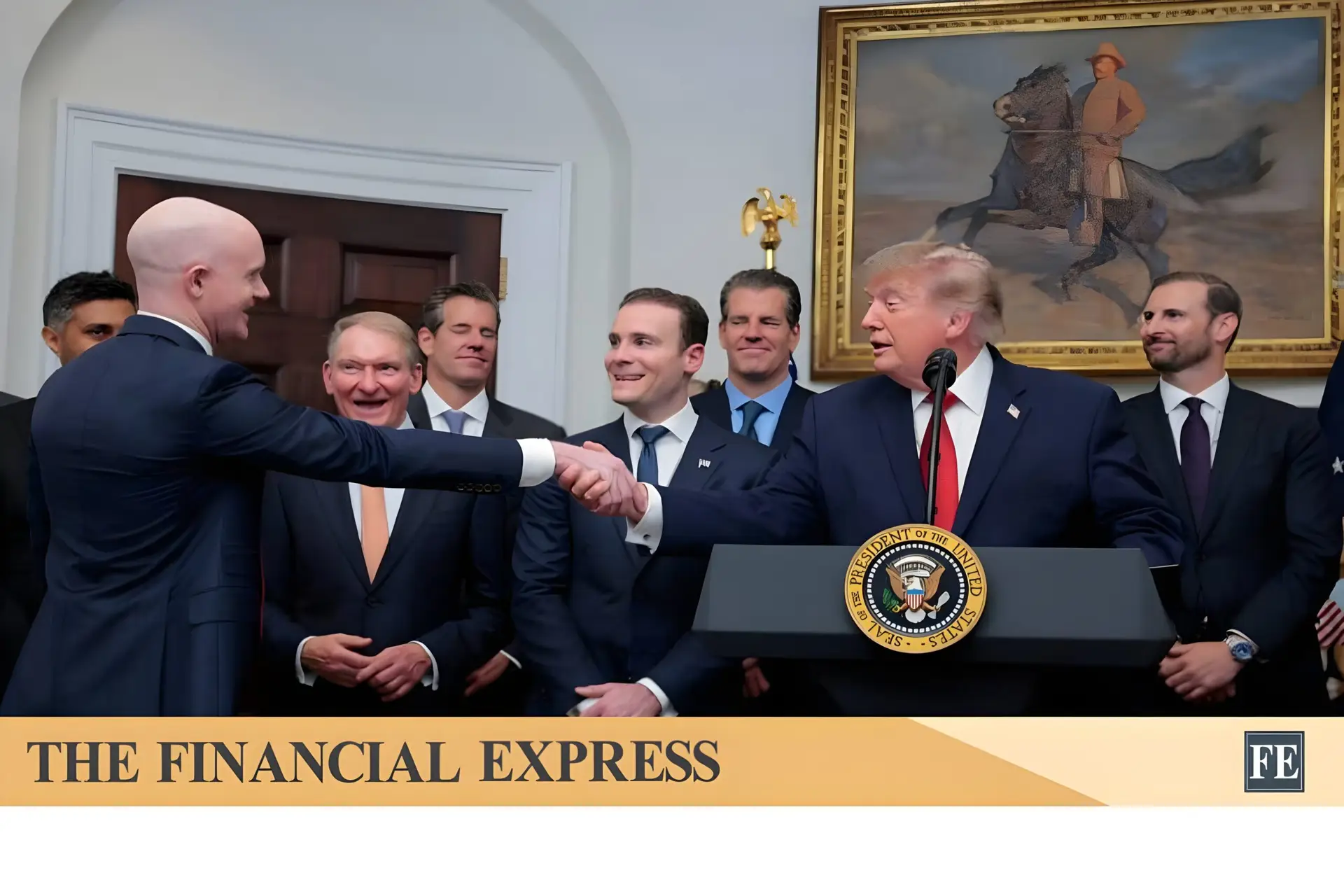
The strategy reshaping 2026 midterm election spending isn’t brand new. It traces back to how the crypto industry organized in the 2024 election cycle. Crypto exchange Coinbase, payments firm Ripple, and venture capital firm Andreessen Horowitz built a super PAC called Fairshake and used it to help defeat longtime Ohio Senator Sherrod Brown, a Democrat who had been one of the industry’s harshest critics in Congress.
Fairshake proved so effective that Public Citizen once described it as a corporate “Death Star” capable of ending individual political careers. Instead of aligning with just one political party, the group backed any candidate, Republican or Democrat, who supported crypto-friendly policies, while targeting those who didn’t. That bipartisan, policy-first approach is now being copied by AI companies, sports betting firms, and other industries.
Brown is now running to reclaim his Senate seat, and strategists from both parties say he’s grown noticeably quieter on crypto issues this time around. His campaign manager, Patrick Eisenhauer, told Reuters that Brown understands cryptocurrency is now part of the American economy and is keeping an open mind about it.
Fairshake started 2026 with a war chest of $193 million and still has roughly $130 million left to spend, according to campaign finance filings. Nearly all of that money came from Coinbase, Ripple, and Andreessen Horowitz. The venture firm’s co-founders, Ben Horowitz and Marc Andreessen, have each personally donated about $4 million this election cycle, with most of it going to President Donald Trump’s MAGA Inc. super PAC. Their firm, Andreessen Horowitz, has separately given more than $81 million to political groups focused mostly on crypto and AI, including at least $23.8 million to Fairshake.
AI Companies Enter the Political Arena for the First Time
Artificial intelligence barely factored into the 2024 elections. This cycle, it’s already a major force. Political groups tied to AI companies OpenAI and Anthropic, which favor different approaches to AI regulation, spent more than $23 million backing two competing Democratic candidates in a single liberal New York City district race in June alone.
Brendan Glavin, director at the nonpartisan watchdog OpenSecrets, described the race as essentially two AI-aligned political groups fighting each other, with the actual candidates becoming secondary players in their broader battle.
An AI-focused super PAC called Leading the Future has raised $140 million for the midterms so far. Much of that funding came from OpenAI co-founder and president Greg Brockman and his wife, Anna, along with additional contributions from Andreessen Horowitz. OpenAI has said it doesn’t finance or direct the group’s activities and that its employees are free to donate their own money however they choose. The Brockmans separately gave $25 million to MAGA Inc.
Anthropic has donated at least $40 million this election cycle through a dark money nonprofit called Public First Action, which has raised $100 million overall. Anthropic is also linked to a super PAC named Public First that has raised $3.9 million, including $1 million from Anthropic co-founder and CEO Dario Amodei personally. The company also runs a smaller traditional PAC funded by employee donations. Anthropic has said its nonprofit spending is meant to educate the public on AI policy rather than to support or oppose specific candidates.
Glavin said the AI industry has essentially copied the crypto playbook from 2024, backing candidates based on their positions rather than their party affiliation.
Online Betting Joins the Fight Over Regulation
Online sports betting companies are following the same strategy as they face growing scrutiny from state and federal regulators. DraftKings, FanDuel, Fanatics, and the U.K.-based sportsbook bet365 have together donated more than $72 million to the 2026 midterms, making betting the third-largest source of corporate political spending this cycle, according to Public Citizen. Most of that money is flowing through two affiliated PACs, American Conservative Fund and American Future, aimed at state races where the industry faces the toughest regulatory battles.
Prediction market Polymarket also gave $1 million in June through its parent company, Blockratize Inc., to the Congressional Leadership Fund, a Republican-aligned super PAC backed by House Speaker Mike Johnson.
Why This Matters for Everyday Americans
The surge in 2026 midterm election spending matters because it shapes which issues get attention in Washington. Claypool noted that about one-third of all corporate political spending recorded since 2010 has occurred during this single election cycle, and the cycle isn’t finished yet.
For voters, that means industries like crypto, AI, and online betting could have outsized influence over which candidates win and what policies get prioritized once they’re in office, even on issues most Americans rarely think about day to day. At the same time, several campaigns are testing whether voters will reward candidates who run against big corporate money rather than benefit from it.
What Happens Next
The current spending totals only cover through the first quarter of 2026, and both parties expect a wave of additional advertising and donations as the November 3 election approaches. Fairshake alone still has roughly $130 million on hand, and groups tied to AI and betting companies are expected to keep raising money through the fall.
Whether this new class of corporate donors can match crypto’s 2024 success, or whether voter backlash against big money in politics blunts their influence, will likely become clearer as primary results and general election polling roll in over the coming months.
How much have companies spent on the 2026 midterm elections so far?
Companies have spent $517 million on U.S. House and Senate races over the 15 months ending in the first quarter of 2026, according to Public Citizen. That already exceeds the $461 million spent during the entire 2024 election cycle, and more spending is expected before November
Which industries are leading 2026 midterm election spending?
Crypto, artificial intelligence, and online sports betting are the three biggest industries fueling corporate donations this cycle. Combined, they’ve contributed at least $294 million toward house and Senate races since January 2025.
What is Fairshake, and why is it important ?
Fairshake is a crypto industry super PAC funded mainly by Coinbase, Ripple, and Andreessen Horowitz. It helped defeat a sitting U.S. senator in 2024 and started 2026 with a $193 million war chest, making it one of the most powerful single-issue political groups in the country.
Are Open AI and Anthropic directly funding political campaigns?
Both companies say they don’t directly finance or direct the political groups linked to them. OpenAI says employees, including co-founder Greg Brockman, are free to donate personally. Anthropic says its dark money nonprofit spending is meant to educate the public on AI policy, not to back specific candidates.
How much is the online betting industry spending on the midterms?
DraftKings, FanDuel, Fanatics, and bet365 have donated more than $72 million combined, making online betting the third-largest source of corporate political spending in the 2026 midterms.
Why are companies giving money to candidates from both political parties?
Many of these industries are using a strategy pioneered by the crypto sector in 2024. Rather than aligning with one party, they back any candidate who supports their policy goals and work to defect those who oppose them, regardless of party affiliation.
One Reply to “2026 Midterm Election Spending Surges $517 million as Crypto AI and Betting Firms Take Lead”